Skip to content

Lee County,through time.

6 eras · 1850–2026 · every fact sourced · compiled from the sources shown, not yet reviewed by a historian

Populationfrom 1890

—

Frontier Fort and Cattle Range

1850–1886: Frontier Fort and Cattle Range

Era 1 · 1850–1886

Frontier Fort and Cattle Range

The Army built Fort Myers on the Caloosahatchee River in 1850 and used it during the Third Seminole War before abandoning it. The 1868-70 war between Spain and Cuba fueled cattle drives through Florida, with Jacob Summerlin and his son dominating the trade in Southwest Florida, and in 1881 a canal to Lake Okeechobee opened the river to steamboat traffic.

Image shown for this era: Page of Frank Leslie's Illustrated Newspaper (October 1858) with an engraving of the two-story wooden block-house at the Army post of Fort Myers. 1858 · Frank Leslie's Illustrated Newspaper, 1858; via Florida Memory and Wikimedia Commons · Public domain · Source

Key moments

  1. Army begins building Fort Myers

    Two artillery companies landed on the Caloosahatchee River and began building a frontier outpost named Fort Myers.

    Source

    1. February 20 is the most significant day in Fort Myers' history, WGCU Public Media (accessed 2026-11-09)
  2. Canal opens the Caloosahatchee to steamboats

    Hamilton Disston connected the Caloosahatchee River to Lake Okeechobee, opening the river to steamboat traffic.

    Source

    1. Historical People & Places (timeline), Edison and Ford Winter Estates (accessed 2026-11-09)
  3. Fort Myers incorporates

    Fort Myers, the future county seat, was incorporated with a population of 349.

    Source

    1. Historical People & Places (timeline), Edison and Ford Winter Estates (accessed 2026-11-09)

Sources

  1. Historical People & Places (timeline), Edison and Ford Winter Estates (accessed 2026-11-09)
  2. Historical People & Places (timeline), Edison and Ford Winter Estates (accessed 2026-11-09)
Correct this era: Frontier Fort and Cattle Range

Era 2 · 1887–1903

A New County on the Gulf

The Florida Legislature created Lee County in 1887 from part of Monroe County, with Fort Myers as the county seat. The county was vast and thinly settled, and stock raising was a leading industry; a 1914 history notes the region had supplied much of Cuba's beef.

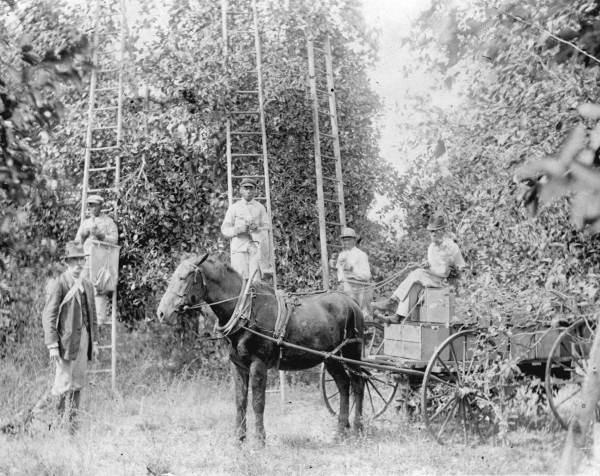
Image shown for this era: Men on tall wooden ladders picking fruit in a citrus grove at Alva, with a mule-drawn wagon loaded with crates in front. 1900 · Unknown photographer; Florida Memory, State Archives of Florida; via Wikimedia Commons · Public domain · Source

Key moments

  1. Lee County is established

    Lee County was established on May 13, 1887, carved from part of Monroe County, as Florida's 41st county. Fort Myers is the county seat.

    Source

    1. FL Maps > County > Lee, Florida Center for Instructional Technology, University of South Florida (accessed 2026-11-09)

Sources

  1. FL Maps > County > Lee, Florida Center for Instructional Technology, University of South Florida (accessed 2026-11-09)
  2. Lee County history (transcribed from George M. Chapin, Florida 1513-1913, Past, Present and Future, 1914), FLGenWeb Lee County (USGenWeb Project) (accessed 2026-11-09)
Correct this era: A New County on the Gulf

Era 3 · 1904–1929

Railroad, Trail and Boom

The Atlantic Coast Line reached Fort Myers in 1904, carrying produce such as flowers and fruit to northern markets, and the 1920s land boom pushed rail lines farther south. In 1923 Collier and Hendry counties were carved out of Lee County, and the Tamiami Trail was completed in 1928.

Image shown for this era: Thomas Edison, naturalist John Burroughs and Henry Ford standing side by side outdoors at Edison's winter home in Fort Myers. 1914 · Hunt, Ft. Myers, Fla., 1914; Library of Congress Prints and Photographs Division (cph.3c31044); via Wikimedia Commons · Public domain · Source

Key moments

  1. Railroad reaches Fort Myers

    The Atlantic Coast Line crossed the Caloosahatchee and reached Fort Myers, opening a new era of development in Southwest Florida.

    Source

    1. Florida Railroads: The Gateway to Flowers, Oranges, & Alligators, Florida Gulf Coast University Library, University Archives & Special Collections (accessed 2026-11-09)
  2. Collier and Hendry counties split from Lee

    Collier County (May 8) and Hendry County (May 11) were both created from parts of Lee County.

    Source

    1. Florida Census: Lee County, Florida Center for Instructional Technology, University of South Florida (from U.S. Census Bureau counts) (accessed 2026-11-09)
  3. Tamiami Trail completed

    The Tamiami Trail linking Tampa and Miami was completed after Lee County's share of construction had stalled for lack of money.

    Source

    1. Tamiami Trail and Monroe Station, National Park Service, Big Cypress National Preserve (accessed 2026-11-09)

Sources

  1. Florida Railroads: The Gateway to Flowers, Oranges, & Alligators, Florida Gulf Coast University Library, University Archives & Special Collections (accessed 2026-11-09)
  2. Florida Census: Lee County, Florida Center for Instructional Technology, University of South Florida (from U.S. Census Bureau counts) (accessed 2026-11-09)
Correct this era: Railroad, Trail and Boom

Era 4 · 1930–1956

Depression, War and the Refuge

The 1929 crash and the rise of the automobile ended the passenger-rail era. During World War II the Army ran Buckingham Field, a flexible gunnery school in northeast Lee County that trained about 50,000 aerial gunners, and in 1945 a national wildlife refuge was created on Sanibel Island.

Image shown for this era: Aerial view of the Buckingham Army Airfield station area in 1944, with rows of barracks and base buildings. 1944 · United States Army Air Forces; via Wikimedia Commons · Public domain · Source

Key moments

  1. Edison Bridge opens

    On Thomas Edison's final birthday, a new bridge named for him opened across the Caloosahatchee River at Fort Myers.

    Source

    1. Bridging the Past and the Future of Fort Myers, Edison and Ford Winter Estates (accessed 2026-11-09)
  2. Buckingham Field gunnery school activated

    The Army activated Buckingham Field, a flexible gunnery school on land in northeast Lee County leased from local officials.

    Source

    1. Buckingham Army Airfield, Museum of Florida History, Florida Department of State (accessed 2026-11-09)
  3. Sanibel wildlife refuge established

    A national wildlife refuge was established on Sanibel Island; it was renamed for conservationist J.N. "Ding" Darling in 1967.

    Source

    1. J.N. "Ding" Darling National Wildlife Refuge: About Us, U.S. Fish & Wildlife Service (accessed 2026-11-09)

Sources

  1. Florida Railroads: The Gateway to Flowers, Oranges, & Alligators, Florida Gulf Coast University Library, University Archives & Special Collections (accessed 2026-11-09)
  2. Buckingham Army Airfield, Museum of Florida History, Florida Department of State (accessed 2026-11-09)
  3. J.N. "Ding" Darling National Wildlife Refuge: About Us, U.S. Fish & Wildlife Service (accessed 2026-11-09)
Correct this era: Depression, War and the Refuge

Era 5 · 1957–1996

Planned Cities and Causeways

Developers broke ground on Cape Coral in 1957 and sold lots nationwide by mail order. The Sanibel Causeway (1963) and Cape Coral Bridge (1964) opened, and the county's census population grew from 105,216 in 1970 to 335,113 in 1990.

Image shown for this era: Construction cranes on barges beside the Sanibel Causeway and its drawbridge span under construction in 1963. 1963 · State Archives of Florida, Florida Memory; via Wikimedia Commons · Public domain · Source

Key moments

  1. Ground broken for Cape Coral

    Leonard and Jack Rosen bought the 103-square-mile Redfish Point tract, and ground was broken for Cape Coral on November 4, 1957.

    Source

    1. History, Chamber of Commerce of Cape Coral (accessed 2026-11-09)
  2. Hurricane Donna strikes Fort Myers

    Hurricane Donna brought sustained winds of 92 mph and gusts to 121 mph to Fort Myers.

    Source

    1. Hurricane Donna - 1960, National Weather Service, Miami-South Florida (accessed 2026-11-09)
  3. Sanibel Causeway opens

    The causeway linked Sanibel Island to the mainland, a turning point for the formerly isolated island.

    Source

    1. Once Upon a Time: An Approachable Guide to the History of Sanibel, Times of the Islands magazine (accessed 2026-11-09)
1 more from this era
  1. Cape Coral Bridge opens

    The two-lane Cape Coral Bridge opened, connecting Cape Coral across the Caloosahatchee.

    Source

    1. History, Chamber of Commerce of Cape Coral (accessed 2026-11-09)

Sources

  1. History, Chamber of Commerce of Cape Coral (accessed 2026-11-09)
  2. 2010 Census of Population and Housing, Population and Housing Unit Counts, CPH-2-11, Florida (Table 4. Population and Housing Units: 1970 to 2010), U.S. Census Bureau (accessed 2026-11-09)
Correct this era: Planned Cities and Causeways

Era 6 · 1997–2026

University, Growth and Storms

Florida Gulf Coast University began classes in 1997, and the county kept growing to 760,822 residents in the 2020 census. Hurricane Charley (2004) and Hurricane Ian (2022) both made landfall at Cayo Costa; Ian's storm surge killed 36 people in Lee County.

Image shown for this era: View from the International Space Station of Cape Coral's canal grid across the Caloosahatchee River from Fort Myers, with barrier islands and the Gulf at left. 2016 · NASA, ISS Expedition 47 crew (ISS047-E-84351); via Wikimedia Commons · Public domain · Source

Key moments

  1. Florida Gulf Coast University opens

    Florida's 10th state university, founded in 1991, began classes between Fort Myers and Naples.

    Source

    1. Our History, Florida Gulf Coast University (accessed 2026-11-09)
  2. Hurricane Charley makes landfall

    Hurricane Charley came ashore near Cayo Costa, just north of Captiva, with maximum sustained winds near 130 knots.

    Source

    1. Tropical Cyclone Report: Hurricane Charley (AL032004), NOAA National Hurricane Center (accessed 2026-11-09)
  3. Hurricane Ian devastates the coast

    Hurricane Ian made landfall on Cayo Costa with 130-knot winds. Its storm surge was the deadliest hazard, and 36 of the 41 surge deaths were in Lee County.

    Source

    1. Tropical Cyclone Report: Hurricane Ian (AL092022), NOAA National Hurricane Center (accessed 2026-11-09)

Sources

  1. Our History, Florida Gulf Coast University (accessed 2026-11-09)
  2. Tropical Cyclone Report: Hurricane Ian (AL092022), NOAA National Hurricane Center (accessed 2026-11-09)
Correct this era: University, Growth and Storms

Then & Now

Lee County, 1887 to 2026

Lee County is established · drag to compare

1926 stereograph card of a downtown Fort Myers business street: two- and three-storey commercial buildings with awnings and a crenellated parapet, a water tower behind, a bus and Model T-era cars in the street, and pedestrians crossing in the foreground
The yellow three-storey Bradford Block with awnings and a coral arcaded corner building in downtown Fort Myers, seen across a brick-paved intersection lined with palms and street lamps under a bright partly cloudy sky
18872026

Then image1926 · Keystone View Company, 1926; Library of Congress Prints and Photographs Division · Public domain · Source

Now image2021 · P. Hughes, CC BY-SA 4.0, via Wikimedia Commons · CC BY-SA · Source

Help us get it right

History is never finished.

This timeline is compiled from the public records cited on each era and event. Every quote is checked against its source automatically, and items marked Reviewed have also been checked by a person. Images are public domain or openly licensed, each with its credit. If you know something we’ve missed or got wrong, or you hold records of your own, we’d like to hear from you.

See what’s happening in Lee County today →