Skip to content

Punta Gorda,through time.

5 eras · 1883–2026 · every fact sourced · compiled from the sources shown, not yet reviewed by a historian

Populationfrom 1990

—

Trabue and the end of the line

1883–1903: Trabue and the end of the line

Era 1 · 1883–1903

Trabue and the end of the line

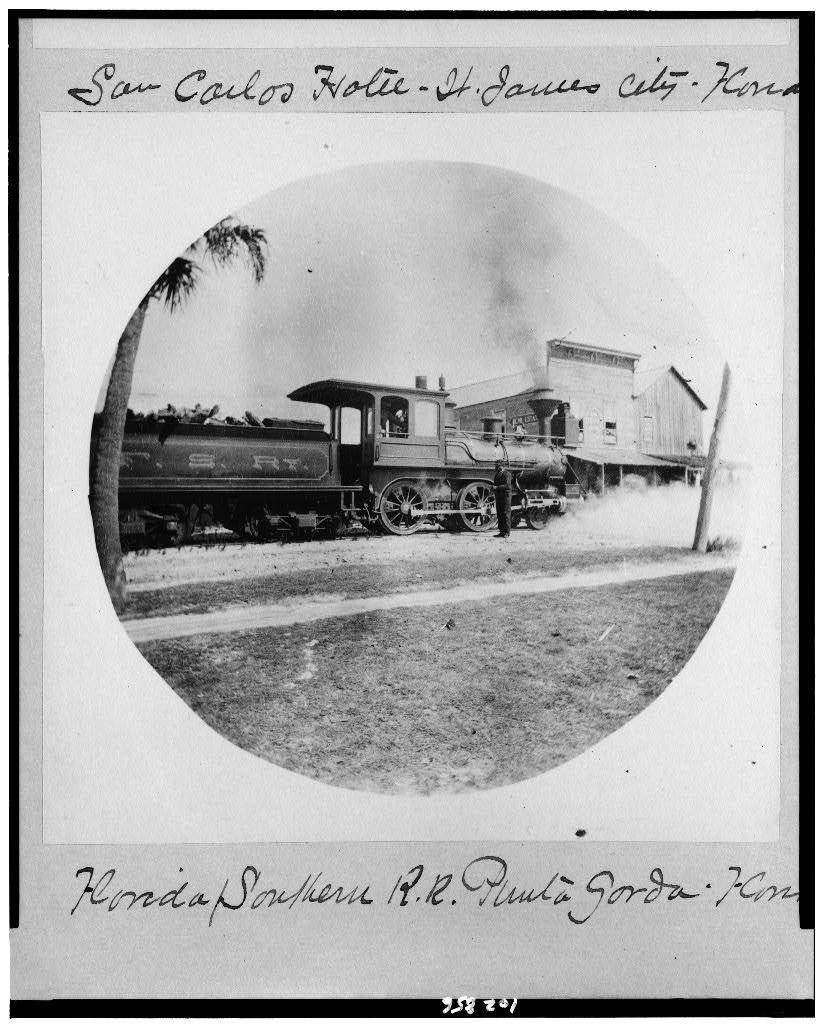
Isaac Trabue began acquiring land in 1883 and had a town platted as Trabue. The Florida Southern Railway reached it in 1886 and its tracks ran out on a 4,000-foot Long Dock, then the southernmost railroad trackage in the U.S.; in 1887 residents incorporated the town as Punta Gorda.

Image shown for this era: Round-framed 1890 photograph of a Florida Southern Railway locomotive and tender stopped on the tracks in Punta Gorda, in front of a two-story wooden commercial building with a false front, a palm tree at left and a sandy street in the foreground; handwritten captions on the mount.. 1890 · J. J. Kirkbride, photographer / Library of Congress, Prints and Photographs Division · Public domain · Source

Key moments

  1. Town platted as Trabue

    Isaac H. Trabue had the town platted under the name Trabue.

    Source

    1. Florida Historical Marker: City of Punta Gorda, Florida Department of State, Division of Historical Resources (accessed 2026-11-09)
  2. Florida Southern Railroad arrives

    The Florida Southern Railroad reached Trabue, and a railroad subsidiary built a large hotel there.

  3. Railroad reaches the Long Dock

    The Florida Southern Railway's narrow-gauge tracks ran out on a 4,000-foot Long Dock, where passengers and freight met steamers to New Orleans, Key West and Havana.

    Source

    1. Florida Historical Marker: Southernmost Railroad Terminal City: Punta Gorda, Florida Department of State, Division of Historical Resources (accessed 2026-11-09)
3 more from this era
  1. Hotel Punta Gorda opens

    The Hotel Punta Gorda, a sprawling wooden resort with a tower overlooking the river, opened as the southernmost first-class hotel in the country.

    Source

    1. Hotel Punta Gorda (mural), Punta Gorda Historic Mural Society (accessed 2026-11-09)
  2. Residents vote to incorporate and rename the town

    Thirty-four men, including four African Americans, met in Tom Hector's building and voted to incorporate the town of Trabue under the name Punta Gorda.

    Source

    1. First City Council (mural), Punta Gorda Historic Mural Society (accessed 2026-11-09)
  3. Punta Gorda incorporated

    Residents of the town of Trabue decided to incorporate as Punta Gorda, walked to the county seat at Pine Level and filed the papers on December 7, 1887.

    Source

    1. Florida Historical Marker: City of Punta Gorda, Florida Department of State, Division of Historical Resources (accessed 2026-11-09)

Sources

  1. Florida Historical Marker: Hector House Plaza: The Founding of Punta Gorda, Florida Department of State, Division of Historical Resources (accessed 2026-11-09)
  2. Florida Historical Marker: Southernmost Railroad Terminal City: Punta Gorda, Florida Department of State, Division of Historical Resources (accessed 2026-11-09)
Correct this era: Trabue and the end of the line

Era 2 · 1904–1920

Fish, ice and phosphate on the harbor

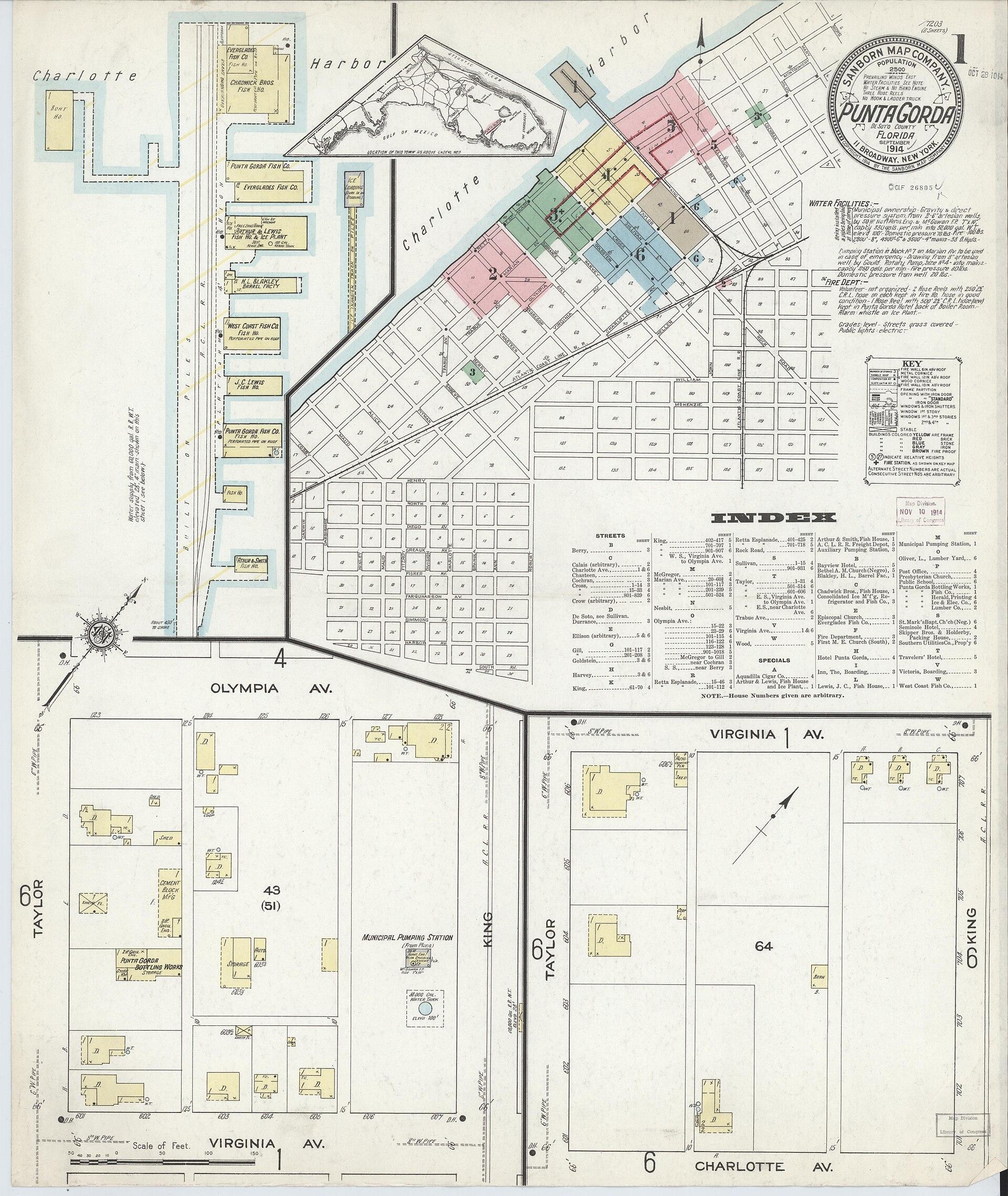
The railroad was extended south in 1904, and the Charlotte Harbor and Northern line to Boca Grande ended phosphate as a major export from Punta Gorda. Commercial fishing, built around the town's ice plant and the long dock, became one of the largest fishing industries in Florida.

Image shown for this era: Key sheet of the 1914 Sanborn fire insurance map of Punta Gorda: a street grid along Charlotte Harbor with colored blocks marking the mapped downtown sheets, a column of fish houses on the long dock at upper left, the street index, and detailed lots along Olympia, Virginia and Charlotte avenues belo. 1914 · Sanborn Map Company / Library of Congress Geography and Map Division, via Wikimedia Commons · Public domain · Source

Key moments

  1. Railroad extended south

    The railroad line that had ended at Punta Gorda was extended farther south.

    Source

    1. Florida Historical Marker: Southernmost Railroad Terminal City: Punta Gorda, Florida Department of State, Division of Historical Resources (accessed 2026-11-09)

Sources

  1. Florida Historical Marker: Southernmost Railroad Terminal City: Punta Gorda, Florida Department of State, Division of Historical Resources (accessed 2026-11-09)
  2. Punta Gorda Multiple Property Group, National Register of Historic Places Multiple Property Documentation Form, National Park Service (accessed 2026-11-09)
Correct this era: Fish, ice and phosphate on the harbor

Era 3 · 1921–1941

County seat and the land boom

In 1921 DeSoto County was divided and Punta Gorda became the seat of the new Charlotte County; the Peace River was bridged the same year on the route of the Tamiami Trail. The boom of the mid-1920s brought a new city hall, courthouse and Mediterranean Revival buildings before the Florida crash and the Depression.

Image shown for this era: Black-and-white oblique aerial view of Punta Gorda in 1924: a grid of streets and buildings along the shore of Charlotte Harbor, with long piers and a dock extending into the water and open land stretching beyond the town.. 1924 · U.S. War Department, Army Air Forces / National Archives and Records Administration (NAID 23936779), via Wikimedia Commons · Public domain · Source

Key moments

  1. Punta Gorda becomes county seat

    DeSoto County was divided into five counties, and Punta Gorda became the seat of the new Charlotte County.

  2. Peace River bridged

    The locally financed Charlotte Harbor bridge, begun in 1916, linked Punta Gorda to the town of Charlotte Harbor and the Tamiami Trail.

  3. Charlotte County Courthouse completed

    A 1926 bond issue paid for the county courthouse, built on land bought from Black entrepreneur George Brown.

2 more from this era
  1. Barron Collier Bridge opens

    Work on the new Barron Collier Bridge began in 1927; it forced the demolition of the railroad dock and the relocation of the depot.

  2. Fire destroys the Maud Street fish dock

    A fire destroyed the fish packing plants on the Maud Street dock, leaving one fish company operating.

Correct this era: County seat and the land boom

Era 4 · 1942–2003

Air base, postwar growth and the waterfront

The Punta Gorda Army Air Base opened in 1942 and revived an economy hit by the 1939 fish-dock fire. After World War II large subdivisions were platted and canal-front Punta Gorda Isles was laid out with 55 miles of canals; in February 1980 Fishermen's Village opened on the site of the old Maud Street fish dock.

Image shown for this era: Vertical black-and-white aerial photograph from April 1944 labeled "Punta Gorda Bridge, Florida": the town's street grid on the left shore, a long bridge crossing the dark water of the Peace River to the opposite shore at right.. 1944 · U.S. War Department, Army Air Forces / National Archives and Records Administration (NAID 23936777), via Wikimedia Commons · Public domain · Source

Key moments

  1. Punta Gorda Army Air Base opens

    The Army air base opened in 1942; soldiers arrived in 1943, and by 1944 it housed 930 officers and 4,162 enlisted men.

  2. Charlotte Harbor Hotel burns

    The town's landmark hotel, built as the Hotel Punta Gorda, was lost to fire.

  3. Fishermen's Village opens

    After the city council allowed the old Maud Street dock to be reused in 1977, Fishermen's Village opened on the site.

    Source

    1. The Maud Street Dock, Punta Gorda History Center (accessed 2026-11-09)

Sources

  1. Punta Gorda Multiple Property Group, National Register of Historic Places Multiple Property Documentation Form, National Park Service (accessed 2026-11-09)
  2. Punta Gorda, Florida, Wikipedia (accessed 2026-11-09)
  3. The Maud Street Dock, Punta Gorda History Center (accessed 2026-11-09)
Correct this era: Air base, postwar growth and the waterfront

Era 5 · 2004–2026

Charley and Ian

Two major hurricanes came ashore at Punta Gorda in eighteen years. Hurricane Charley's eyewall struck the city on August 13, 2004, and on September 28, 2022, the center of Hurricane Ian's large eye made landfall near Punta Gorda.

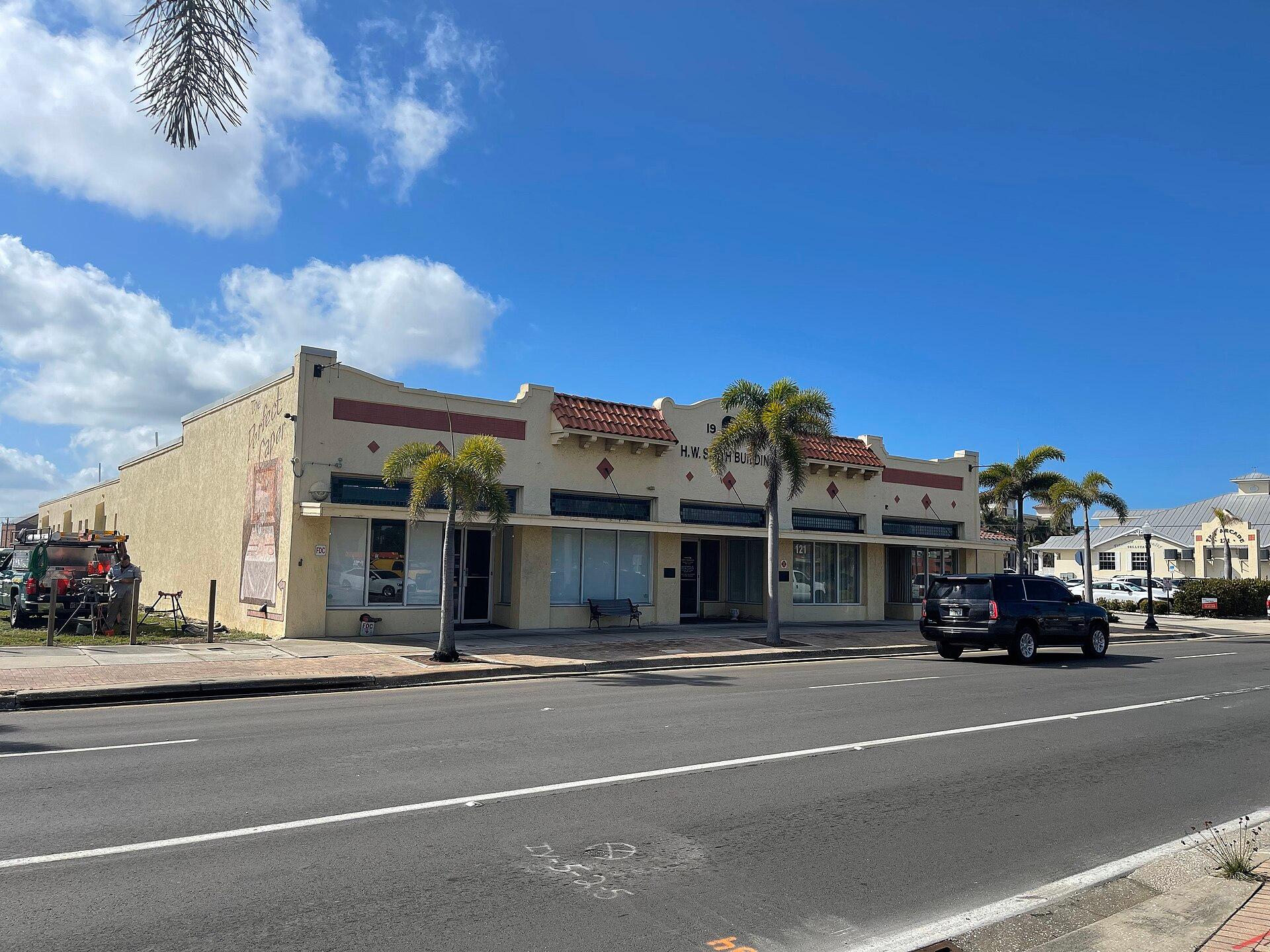
Image shown for this era: The cream-colored, Mediterranean Revival H. W. Smith Building on Marion Avenue in downtown Punta Gorda in 2025, with red tile accents, storefront windows and palm trees along the sidewalk under a bright blue sky.. 2025 · PCHS Pirate Alumnus, CC BY-SA 4.0, via Wikimedia Commons · CC BY-SA · Source

Key moments

  1. Hurricane Charley strikes Punta Gorda

    Charley made landfall near Punta Gorda; its eyewall struck the city, and the airport wind sensor failed after measuring sustained winds of 78 knots with a gust to 97.

    Source

    1. Tropical Cyclone Report: Hurricane Charley, NOAA National Hurricane Center (accessed 2026-11-09)
  2. Hurricane Ian makes landfall near Punta Gorda

    After landfall on Cayo Costa, the center of Ian's large eye came ashore again near Punta Gorda.

    Source

    1. Tropical Cyclone Report: Hurricane Ian, NOAA National Hurricane Center (accessed 2026-11-09)

Sources

  1. Tropical Cyclone Report: Hurricane Charley, NOAA National Hurricane Center (accessed 2026-11-09)
  2. Tropical Cyclone Report: Hurricane Ian, NOAA National Hurricane Center (accessed 2026-11-09)
Correct this era: Charley and Ian

Then & Now

Punta Gorda, 1887 to 2026

Punta Gorda incorporated · drag to compare

Round-framed 1890 photograph of a Florida Southern Railway locomotive and tender stopped on the tracks in Punta Gorda, in front of a two-story wooden commercial building with a false front, a palm tree at left and a sandy street in the foreground; handwritten captions on the mount.
The cream-colored, Mediterranean Revival H. W. Smith Building on Marion Avenue in downtown Punta Gorda in 2025, with red tile accents, storefront windows and palm trees along the sidewalk under a bright blue sky.
18872026

Then image1890 · J. J. Kirkbride, photographer / Library of Congress, Prints and Photographs Division · Public domain · Source

Now image2025 · PCHS Pirate Alumnus, CC BY-SA 4.0, via Wikimedia Commons · CC BY-SA · Source

Help us get it right

History is never finished.

This timeline is compiled from the public records cited on each era and event. Every quote is checked against its source automatically, and items marked Reviewed have also been checked by a person. Images are public domain or openly licensed, each with its credit. If you know something we’ve missed or got wrong, or you hold records of your own, we’d like to hear from you.

See what’s happening in Punta Gorda today →